
By Sai Donti, co-owner of Horizon Home Solutions · Last reviewed November 2026
The foreclosure process in Georgia can take as little as about a month from the notice letter to the courthouse sale, because Georgia lets a lender foreclose without going to court. Most of the timeline comes before that letter: federal servicing rules generally keep a servicer from starting foreclosure until the loan is more than 120 days behind.
Part of your timeline is set by state and federal law. The rest depends on the loan, the servicer and what you decide to do. Each step is below, in order, with the law behind it. If you’d rather look at your options than the dates, see our page on behind on mortgage payments in Georgia.
This is general information, not legal advice. Already have a notice or a sale date? Call a Georgia attorney or a free HUD-approved housing counselor as soon as you can.
How long does foreclosure take in Georgia?
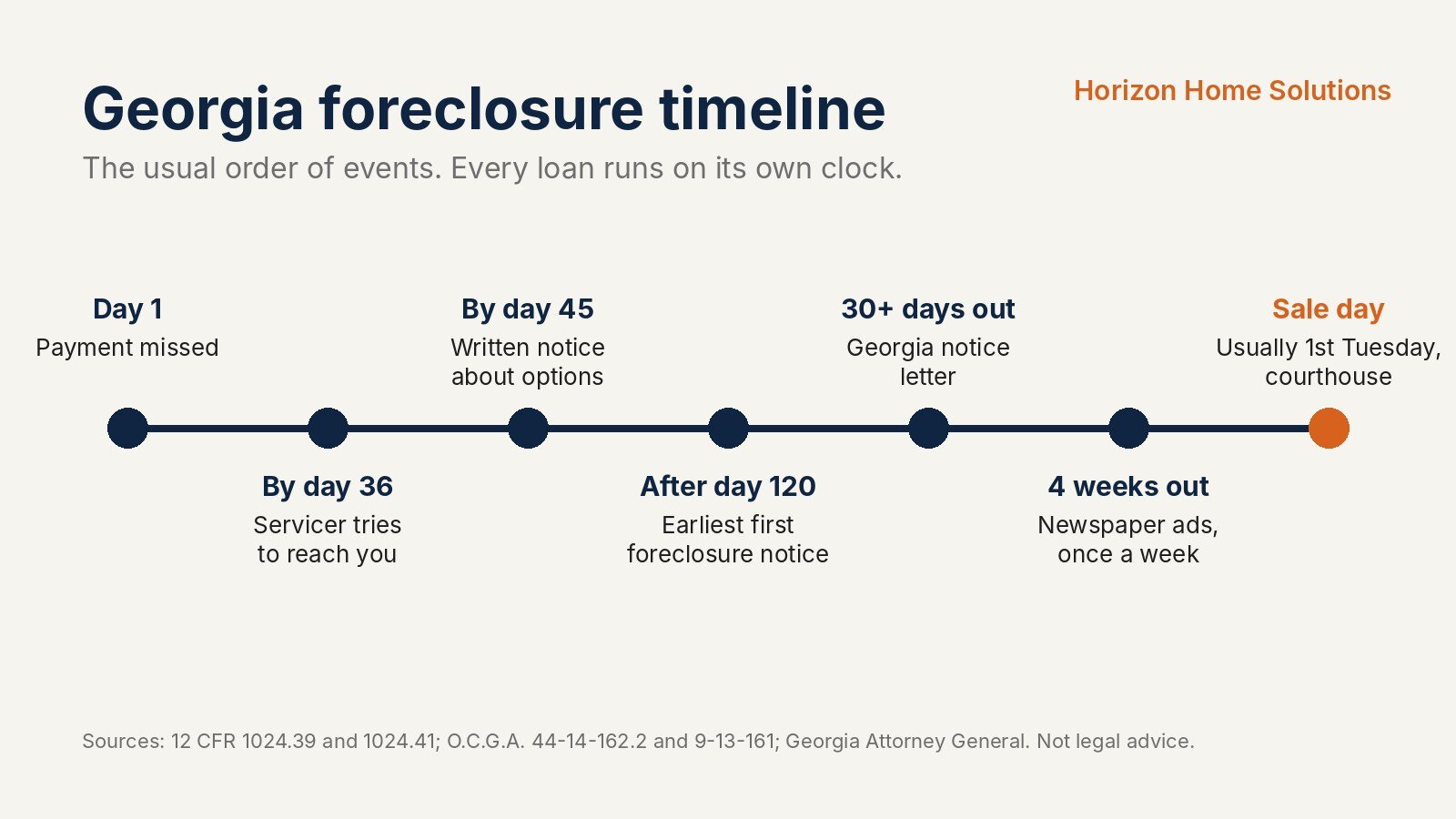
| When | What usually happens | Source |
|---|---|---|
| Payment due date | Payment missed. The loan is now delinquent. | Your loan documents |
| By day 36 | Servicer has to try to reach you live. | 12 CFR 1024.39(a) |
| By day 45 | Servicer has to send a written notice about options. | 12 CFR 1024.39(b) |
| After day 120 | Earliest the servicer can usually make the first foreclosure notice. | 12 CFR 1024.41(f) |
| 30+ days before the sale | Georgia notice letter, by certified or registered mail or statutory overnight delivery. | O.C.G.A. 44-14-162.2 |
| 4 weeks before the sale | Sale advertised once a week in the county’s legal newspaper. | Georgia Attorney General |
| Sale day | Usually the first Tuesday of the month, at the courthouse, 10 a.m. to 4 p.m. | O.C.G.A. 9-13-161; Georgia Attorney General |
Don’t count days off this table. Every loan runs on its own clock. These federal steps cover most mortgages on a home the owner lives in, but some loans and small servicers follow different rules. Ask your servicer which rules apply to you.
What that looks like on a calendar
Here’s a made-up example. Say the payment due March 1 doesn’t get made.
- Early April: the servicer has to have tried to reach you by phone or in person.
- Mid-April: a letter about your options should have arrived.
- Late June: the loan passes 120 days late. Only now can the foreclosure itself usually begin.
- After that: a notice letter at least 30 days before the sale, plus four weeks of newspaper ads. In this example, the earliest sale would likely be a first Tuesday in August.
That’s roughly five months, and it’s the fast version. Your servicer can take longer. On a loan these rules cover, it usually can’t go much faster.
Days 1 to 45: the missed payment
Once a payment is missed, the loan is delinquent. At this stage, nothing has been filed.
Federal rules do make the servicer reach out. By day 36, it must try to reach you live, by phone or in person (12 CFR 1024.39). By day 45, it must also send a letter listing options it may offer, such as a repayment plan or a loan modification.
Neither one is a foreclosure notice. Answer them anyway. This early stretch is usually when you have the most time to work something out.
Day 120: the federal waiting period
Under 12 CFR 1024.41(f), a servicer generally may not make the first foreclosure notice or filing until the loan is more than 120 days delinquent. There are a few exceptions, such as a due-on-sale violation.
Section 1024.41(g) adds a 37-day mark. Where a complete loss mitigation application reaches the servicer more than 37 days before a scheduled sale, the servicer generally may not go ahead with the sale until it has told the borrower they don’t qualify for any option and any appeal is over, or the borrower turns down or doesn’t keep to an option it offers. This usually works only once: under section 1024.41(i), a servicer that already reviewed a complete application generally doesn’t have to do it again if the borrower has stayed behind since.
Don’t count on that protection alone. The Georgia Attorney General reports that houses have been sold while modification applications were still pending. If your servicer says the sale is on hold, ask for that in writing.
30 days out: the Georgia foreclosure notice letter
O.C.G.A. 44-14-162.2 requires written notice at least 30 days before the sale. The notice must be sent by registered or certified mail, or by statutory overnight delivery, with return receipt requested.
Look for one line in it: the name, address and phone number of the person or entity with full authority to negotiate, amend and modify the loan. The law requires it. Write it down.
Two more points from the Attorney General’s page: a copy of the sale ad comes with the letter, and refusing the certified letter doesn’t make the notice invalid.
4 weeks out: the foreclosure ad in the legal newspaper
The sale is advertised in the county’s legal organ, which is the newspaper used for official notices, once a week for four consecutive weeks (Georgia Attorney General). Anyone can read these ads.
Before the sale: proof of ownership
Whoever holds the loan must file proof that it owns the loan with the clerk of superior court in the county where the house is. Usually that’s an assignment of the note and security deed (Georgia Attorney General).
When are foreclosure sales held in Georgia?
Georgia foreclosure sales are usually held at the county courthouse on the first Tuesday of the month, between 10 a.m. and 4 p.m. (Georgia Attorney General). If that Tuesday is New Year’s Day or the Fourth of July, the sale moves to the Wednesday after (O.C.G.A. 9-13-161). The foreclosure statute ties the sale to the county’s sheriff’s sale practice (O.C.G.A. 44-14-162).
It’s a public auction, so anyone can bid. The Attorney General notes that the lender is often the only bidder. Whoever wins gets a deed and owns the house.
What happens after a foreclosure sale in Georgia?
According to the Georgia Attorney General, a valid foreclosure ends the former owner’s right to live in the house. If the former owner stays, the new owner can file a dispossessory action, Georgia’s version of an eviction case. Some lenders offer “cash for keys” instead: a payment to move out on your own.
If the house sells for less than you owe, the lender can’t go after the difference unless it takes extra steps first. It must report the sale to a superior court judge within 30 days and obtain confirmation, and the judge must be satisfied that the house sold for its true market value (O.C.G.A. 44-14-161). If you get notice of a confirmation hearing, talk to an attorney.
Who to call about a Georgia foreclosure notice
- Your servicer. The number is on your mortgage statement. Ask what options they offer and what paperwork they need.
- A HUD-approved housing counselor. Free. Find one at consumerfinance.gov/mortgagehelp.
- A Georgia attorney. The Attorney General’s page lists the State Bar of Georgia and local legal aid organizations.
One warning: if someone asks for money up front to “handle” your lender, or wants you to sign over the deed to “save” the house, don’t go ahead. The CFPB and the Attorney General both warn about these schemes.
Georgia foreclosure FAQ
Is Georgia a judicial or non-judicial foreclosure state?
Georgia lets lenders foreclose without going to court, which is usually called non-judicial foreclosure (Georgia Attorney General). That’s why the state-law part of the process is short.
What if I refuse the certified letter?
Refusing a notice sent by registered or certified mail doesn’t make it invalid (Georgia Attorney General).
Who can bid at a Georgia foreclosure sale?
Bidding is open to the public, but the mortgage holder is often the only bidder (Georgia Attorney General).
Can the lender come after me for the rest of the balance?
Only after extra steps. The lender must report the sale to a superior court judge within 30 days and get it confirmed, and the judge must be satisfied that the house sold for its true market value (O.C.G.A. 44-14-161). If you get notice of a confirmation hearing, talk to an attorney.
Can you sell your house before a Georgia foreclosure sale?
Selling before the sale date may be one option. We are real estate investors, not agents, and we don’t represent you. See how our process works. We can make you an offer to buy your house. If the sale closes before the foreclosure date and covers what you owe, the loan is paid off and the foreclosure ends there. We don’t negotiate with your lender. Free help is available from your lender and from HUD-approved housing counselors. Find one at consumerfinance.gov/mortgagehelp.
If selling is the right call for you, we buy in any condition, with or without tenants, and we clean out whatever is left behind. Offers are in writing, usually the same day or the next day. Getting an offer doesn’t commit you to anything. Sai or Greg will call and meet you, weekends too. A Georgia closing attorney, often working with a title company, handles the closing. We usually work with Ashway Law Firm but are happy to work with others. We buy houses across metro Atlanta and North Georgia, including Gwinnett, DeKalb, Clayton, Forsyth and Hall counties.
Timing depends on title, the lender’s payoff and you. More on your options: behind on mortgage payments in Georgia. Or request an offer and decide from there.
This article is general information, not legal advice. Foreclosure timelines depend on the loan and the facts of each case. A Georgia attorney or a HUD-approved housing counselor can advise on individual situations.
About the author: Sai Donti is the manager and co-owner of Horizon Home Solutions, a Georgia real estate investment company that buys houses directly from owners in metro Atlanta and North Georgia. He’s also the author of Currency of Mindset. More from Sai at SaiDonti.com.