
By Sai Donti, owner of Horizon Home Solutions · Last reviewed November 2026
Heirs property in Georgia is a house or land that passed to several relatives at once, such as when the owner died without a will, so the family owns it together. A house like this can be sold, but usually not until the title is cleared: a buyer needs every owner to sign, or a court order that allows the sale, and a clear record of who those owners are.
It often starts when an older relative dies and the family keeps living in the house or paying the taxes without opening an estate. The deed may still be in the name of the person who died, sometimes decades later. Nothing seems wrong until someone wants to sell, refinance or apply for a repair grant. Then it can be hard to prove who owns the house. For the wider steps, see our page on selling an inherited house in Georgia.
This is general information, not legal advice. Who can sell heirs property, and when, depends on your family’s situation, the probate court and Georgia law. Talk to a Georgia probate or real estate attorney.
What is heirs property in Georgia?
As explained by the Georgia Heirs Property Law Center, heirs property is property passed to several people in a family, either because the owner died without a will or because a will left it to more than one person. The relatives then own it together as tenants in common. Each person owns a share of the whole house, not a certain room or piece of land.
Georgia law also has a narrower definition for when co-owners go to court to divide or sell. Under O.C.G.A. 44-6-180, property held by tenants in common counts as heirs property if all three are true:
- No written agreement signed by all the owners covers dividing it.
- At least one owner got their share from a relative.
- Relatives hold at least 20% of the shares, or make up at least 20% of the owners. (The statute has one more version of this 20% test. An attorney can tell you if it fits.)
Who inherits a house in Georgia when there’s no will?
The rules in Georgia are set out in O.C.G.A. 53-2-1. In general terms:
- A spouse and children share the estate, although the spouse’s share cannot be less than one-third.
- Where there is no spouse, the heirs are the closest living relatives, beginning with the children.
If a child died before the parent, that child’s share goes to the child’s own children. If an heir dies later, their share passes through their own estate. That’s how one house can end up with many co-owners in different states. The Muscogee County (Columbus) Probate Court has a plain-language summary of these rules. A probate attorney can tell you how they apply to your family.
Example (made up): A mother dies without a will and with no spouse. She had three children, but one of them died before her and left two kids. The two surviving children each inherit a share, and the two grandchildren split their parent’s share. Years later, one of the surviving children dies, and that share passes through their own estate. The house that had one owner can now have four, five or more.
Does the family already own the house?
Legally, the family may well own it. When someone dies without a will, title to their real estate vests in the heirs right away (O.C.G.A. 53-2-7). However, that title can be displaced if an administrator is appointed. Once that happens, the administrator has the right to possess and manage the property.
The problem is proof.
Without a court ruling, the public record usually doesn’t show who the heirs are. A buyer, lender or title insurance company needs a clear chain of title before closing. Without one, selling or borrowing against the house can be hard. The Law Center also notes that most home repair programs require clear title, or written agreement from all of the heirs (Georgia Heirs Property Law Center).
Why selling heirs property gets stuck
- Every owner has to sign. To buy the whole house, a buyer needs every owner’s signature, or a court order that allows the sale.
- Some heirs cannot be found. People move away, lose contact, or do not realize they have inherited anything.
- One person may refuse. A single co-owner can hold up a sale that the rest of the family wants.
- The bills keep coming. Taxes, insurance and upkeep still need to be paid while the family sorts it out.
How families clear title to heirs property
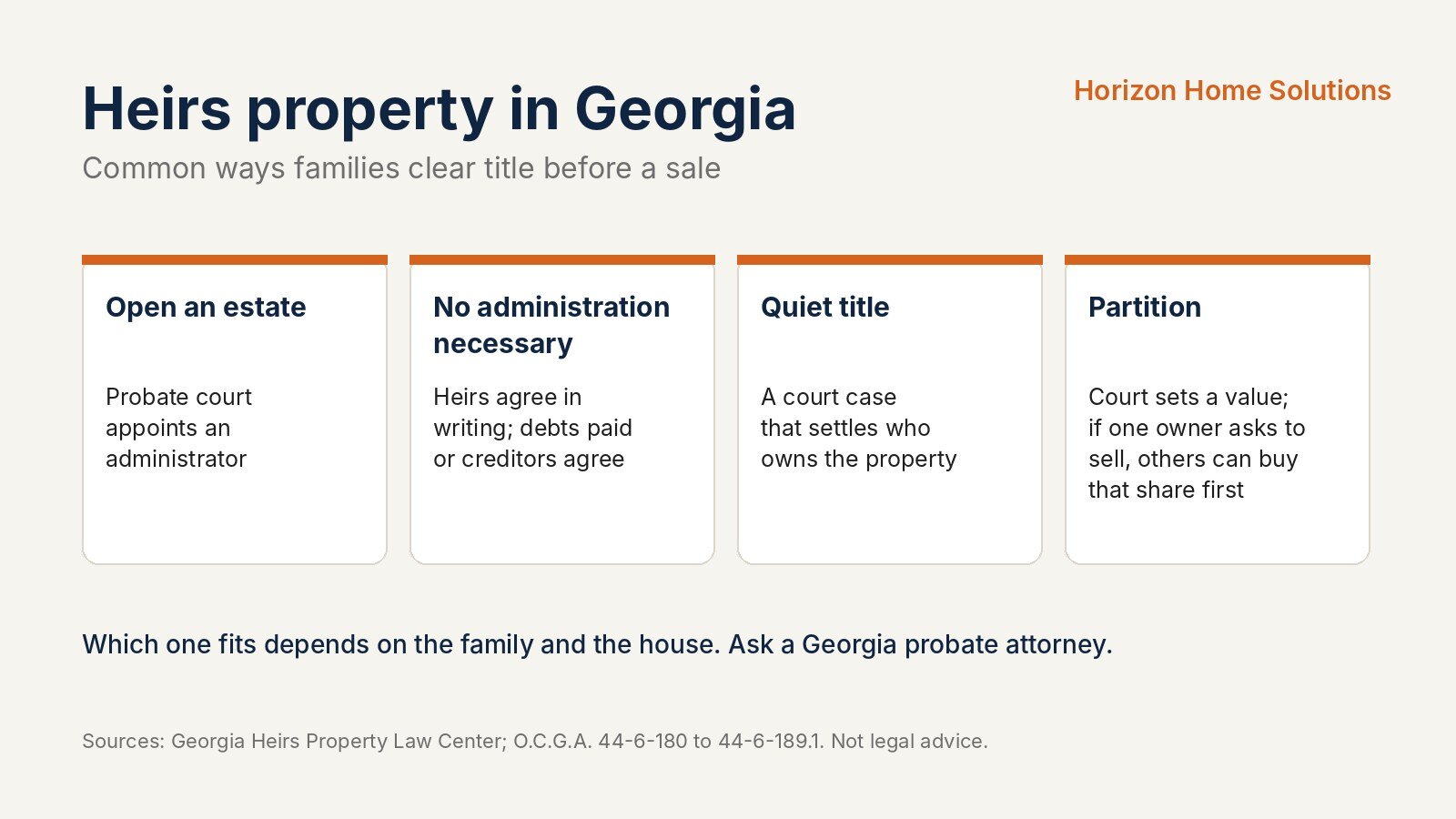
The usual paths are an agreement among the heirs, probate, or a quiet title action (Georgia Heirs Property Law Center). An attorney can tell you which fits your family and the house.
Opening an estate. Someone asks the probate court to appoint an administrator, who is then able to deal with the property. Our article on the probate process in Georgia explains the steps.
No administration necessary. Where there is no will, all of the heirs agree in writing, and the debts have been paid or the creditors agree, the heirs can petition the probate court to declare that no administration is necessary (O.C.G.A. 53-2-40). This is covered in the same probate article.
Quiet title. A court case that decides who owns the property.
Partition. If co-owners can’t agree, any one of them can ask a court to divide the property or sell it. For heirs property, Georgia adds protections under its version of the Uniform Partition of Heirs Property Act (O.C.G.A. 44-6-180 and following). If the court finds it is heirs property:
- The court sets the fair market value first, usually through an appraisal.
- If one owner asked for a sale, the other owners can buy that owner’s share at that value.
- If no one does, the court generally divides the land instead, unless dividing it would cause “manifest prejudice” to the owners as a group.
- Only then, and only if someone asked for a sale, does the court order one.
Heirs property FAQ
Do all the heirs have to agree to sell the house?
To buy the whole house, a buyer needs every owner to sign, or a court order that allows the sale. If co-owners can’t agree, any one of them can ask a court to divide or sell the property, with the extra protections described under Partition above.
Can we get an offer before the title is cleared?
Yes. If the title still needs work, you can still get an offer first. A sale can’t close until it’s clear who has the right to sign.
Where to get help
- Georgia Heirs Property Law Center. A nonprofit law firm that offers no-cost legal services to heirs property owners, with a focus on low- and moderate-income Georgians. Its staff work across the state, with targeted outreach in Atlanta and southwest Georgia. Contact them to see if you qualify.
- A Georgia probate or real estate attorney. Especially important if there’s a will, a dispute, or heirs nobody can find.
- The county probate court. Clerks can explain forms and deadlines, but they cannot give legal advice.
Selling heirs property to Horizon
We are real estate investors, not agents, and we don’t represent you. See how our process works. We buy inherited houses. We work with the estate’s executor or administrator and their attorney. A sale can’t close until it’s clear who has the right to sign.
We buy in any condition, with or without tenants, and we clean out what you leave behind. Offers are in writing, usually the same day or the next day. Getting an offer doesn’t commit you to anything. Sai or Greg will call and meet you, weekends too. A Georgia closing attorney, often working with a title company, handles the closing. We usually work with Ashway Law Firm but are happy to work with others. We buy houses across metro Atlanta and North Georgia, including Gwinnett, DeKalb, Clayton, Forsyth and Hall counties.
Title still needs work? You can still get an offer first and see where you stand. Request an offer and decide from there.
Horizon Home Solutions does not give legal advice. Who can sell an estate’s property, and when, depends on the will, the probate court and Georgia law. Please talk to a Georgia probate attorney.
About the author: Sai Donti is the manager and owner of Horizon Home Solutions, a Georgia real estate investment company that buys houses directly from owners in metro Atlanta and North Georgia. He’s also the author of Currency of Mindset. More from Sai at SaiDonti.com.