
By Sai Donti, owner of Horizon Home Solutions · Last reviewed November 2026
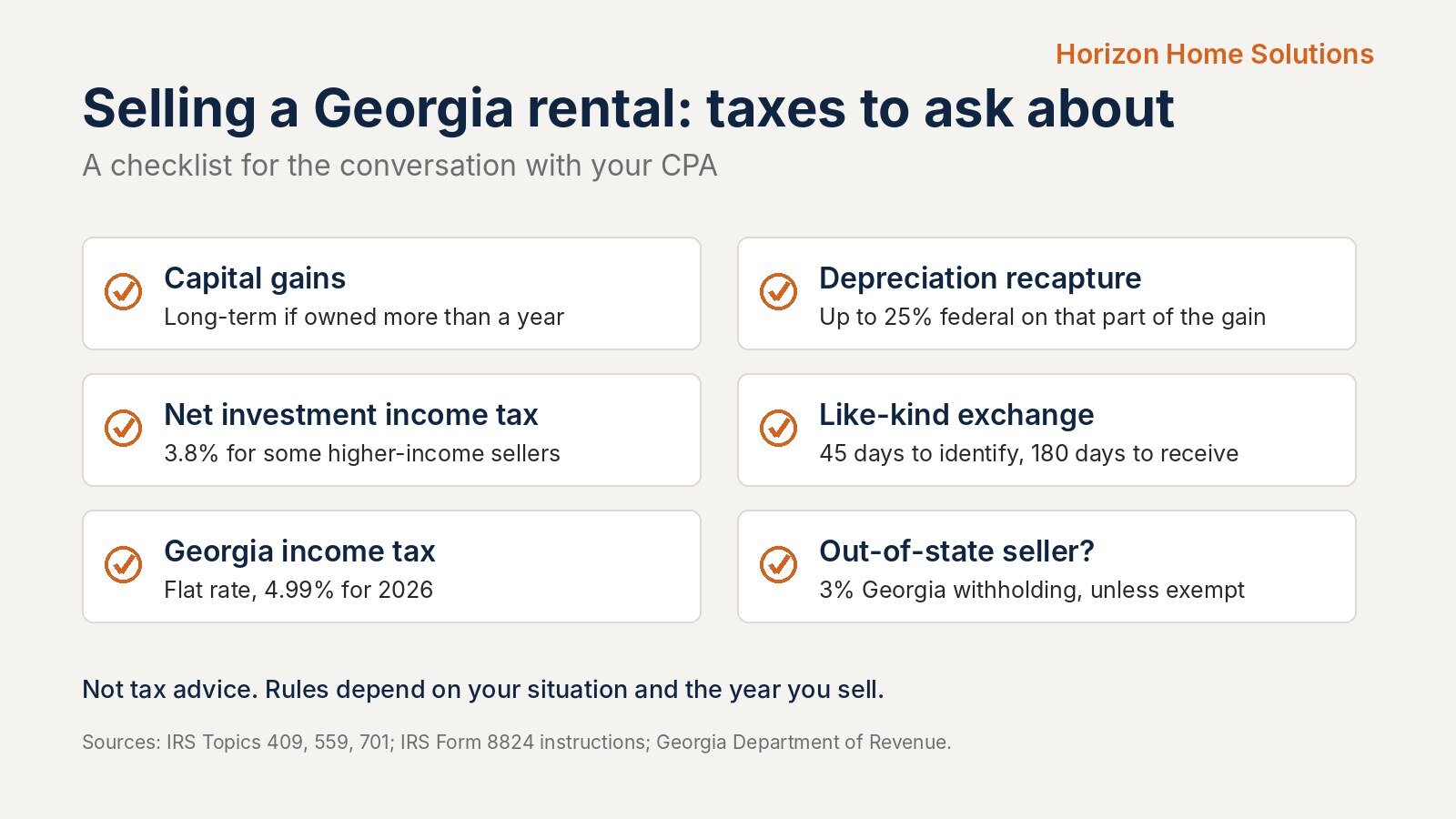
Taxes when selling a rental property in Georgia can include federal capital gains tax, up to 25% on the part of the gain that comes from depreciation, and the 3.8% net investment income tax for higher incomes. If you don’t live in Georgia, the buyer is generally required to withhold 3% of the price for the state. Depreciation is often the part that surprises people.
All information below comes from the IRS, the Georgia Department of Revenue or Georgia’s tax regulations, and each item links to its source, so you and your CPA can check it. Haven’t decided to sell yet? Start with our guide to selling a rental property in Georgia.
This is general information, not tax advice. Go over these points with your CPA or tax professional before you sell.
Federal capital gains tax on a rental sale
How the gain is taxed depends on how long you owned the property and how you used it (IRS Publication 544).
Owned it more than a year? That’s a long-term gain, usually taxed at a lower rate. Owned it a year or less? That’s a short-term gain, taxed like ordinary income (IRS Topic 409).
Your adjusted basis usually starts with what you paid. It goes up with capital improvements and down by any depreciation you took (or could have taken) (IRS Publication 544).
Depreciation recapture: the part taxed at up to 25%
Each year you owned the rental, you could claim depreciation on the building, and each year that lowered your basis. So part of your gain may come from depreciation. The IRS calls that part unrecaptured section 1250 gain, and it’s taxed at up to 25% (IRS Topic 409).
Example (made-up numbers, ignoring selling costs and improvements): You bought a rental for $200,000 and took $40,000 of depreciation over the years, so your adjusted basis is $160,000. You sell for $300,000, a $140,000 gain. The $40,000 depreciation part can be taxed at up to 25%. The other $100,000 is taxed as a capital gain, long-term if you owned it more than a year. Your CPA works out the real numbers.
- Not claiming it does not avoid it. Even if you never claimed depreciation, your basis still goes down by the amount you could have claimed (IRS Publication 544). If that’s you, ask your CPA what it means for your return.
- Forms. The sale usually goes on Form 4797, and the gain may carry to Schedule D (IRS Publication 544).
Federal: the 3.8% net investment income tax
Higher earners may owe this too. It’s 3.8% of whichever is smaller: your net investment income, or the amount your modified adjusted gross income is over $200,000 ($250,000 if married filing jointly, $125,000 if married filing separately). Gains from selling real estate usually count, but there are exceptions for some property held in a business (IRS Topic 559).
“Can’t I use the home sale exclusion?”
For a house that has only been rented out, usually not. To qualify, you must have owned the home and lived in it as your main home for at least two of the five years before the sale (IRS Topic 701). Different rules apply if you lived there before or after renting it out, so give your CPA your move-in and move-out dates. Even if the exclusion applies, the part of the gain that equals depreciation allowed or allowable after May 6, 1997 cannot be excluded (IRS Publication 523).
Deferring the tax with a like-kind exchange
A like-kind exchange, often called a 1031 exchange, lets you put off paying tax on the gain when you trade one investment or business property for another. Since 2018, it only applies to real property. Property that is held mainly for sale does not qualify.
The deadlines are strict. The replacement property must be identified within 45 days of the sale. You must then receive it within 180 days, or by the due date of the tax return including extensions, whichever comes first. A qualified intermediary can be used in a deferred exchange (IRS Instructions for Form 8824).
Georgia’s 2026 income tax rate
Georgia’s individual income tax rate for 2026 is a flat 4.99% (Georgia Department of Revenue). State law also schedules further annual cuts, so check the rate for the year in which the sale takes place (Office of the Governor).
Selling a Georgia rental as a nonresident: 3% withholding
If a nonresident sells real estate in Georgia, the buyer generally has to withhold 3% of the price and send it to the state. Or the seller can sign an affidavit of the actual gain, and then 3% of the gain is withheld (Georgia Department of Revenue, Form G2-RP).
Some sales are exempt. One example: a Department of Revenue rule says no withholding is needed when the price is under $20,000 (Ga. Comp. R. & Regs. 560-7-8-.35). A nonresident who meets several conditions can also sign an affidavit to be treated as a resident (Georgia Department of Revenue).
The amount withheld isn’t your final tax. You attach a copy of Form G2-RP when you file your Georgia return (Georgia Department of Revenue).
Rental sale tax FAQ
How long do I have to own the rental to get long-term rates?
More than a year. If you’ve owned it for 1 year or less, the gain is short-term and taxed the same way as ordinary income (IRS Topic 409).
Does skipping depreciation lower the tax when I sell?
No. If you don’t claim depreciation, the basis is still reduced by the depreciation that could have been taken (IRS Publication 544).
Which IRS form reports the sale of a rental?
Generally Form 4797. The gain may then carry to Schedule D (IRS Publication 544).
Is the Georgia withholding the final tax for a nonresident?
No. The amount withheld isn’t the final tax. The seller attaches a copy of Form G2-RP when filing their Georgia return (Georgia Department of Revenue).
What to bring to your CPA
- The closing statement and date from the original purchase
- Receipts for capital improvements, such as a roof, HVAC or an addition
- Depreciation schedules from past returns
- The years you lived in the house, if you ever did
- Whether you want to consider a like-kind exchange
- The state you currently live in
Selling a rental to Horizon
We are real estate investors, not agents, and we don’t represent you. See how our process works.
We buy in any condition, with or without tenants, and we clean out what you leave behind. Offers are in writing, usually the same day or the next day. Getting an offer doesn’t commit you to anything. Sai or Greg will call and meet you, weekends too. A Georgia closing attorney, often working with a title company, handles the closing. We usually work with Ashway Law Firm but are happy to work with others. We buy houses across metro Atlanta and North Georgia, including Gwinnett, DeKalb, Clayton, Forsyth and Hall counties.
Want a number to run past your CPA? Request an offer and decide from there, or see how a cash offer compares with listing.
Horizon Home Solutions does not give tax advice. Selling a house can have tax effects. Please talk to a CPA or tax professional.
About the author: Sai Donti is the manager and owner of Horizon Home Solutions, a Georgia real estate investment company that buys houses directly from owners in metro Atlanta and North Georgia. He’s also the author of Currency of Mindset. More from Sai at SaiDonti.com.